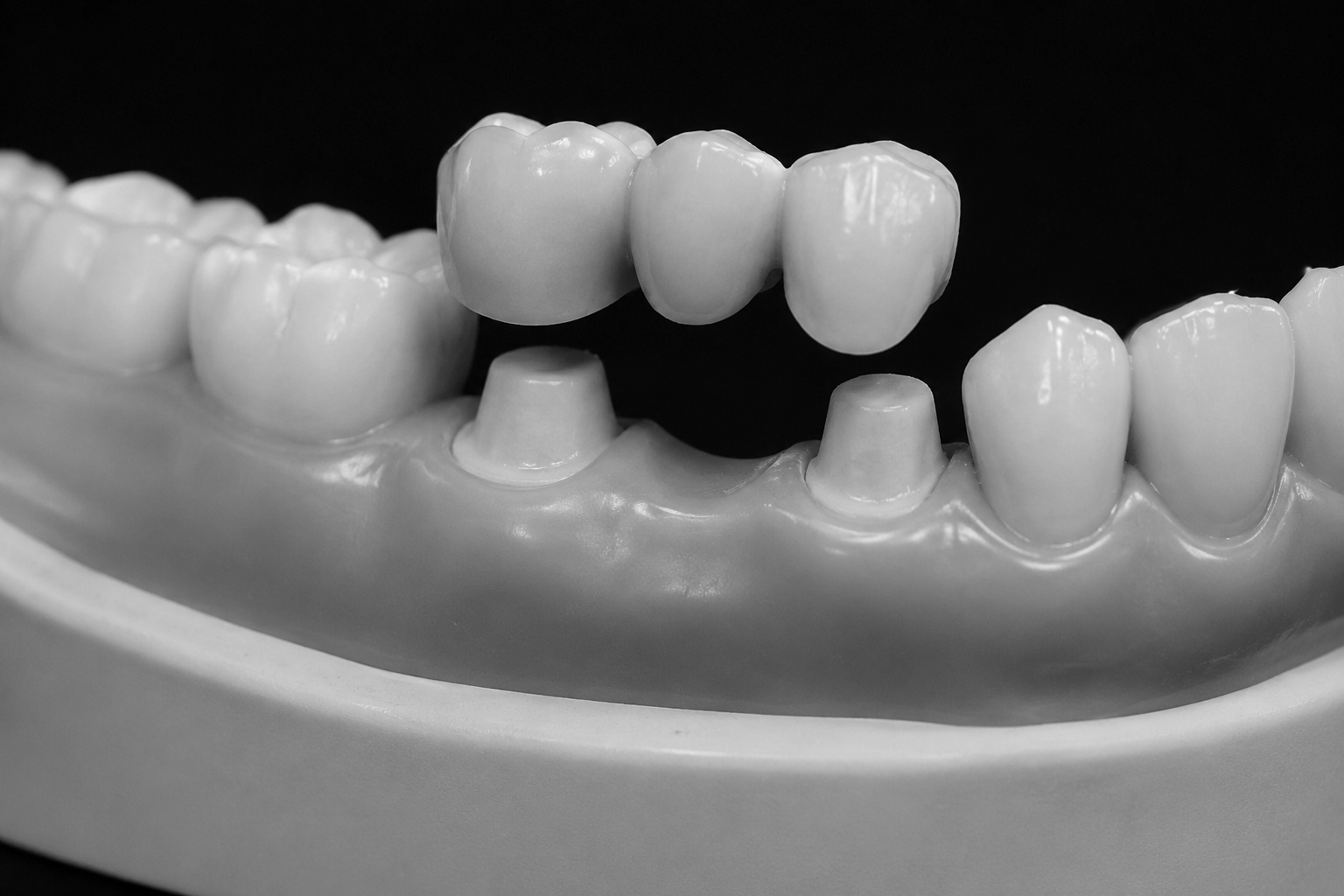
Crowns and Bridges
When a tooth is too weakened to rely on a filling alone, a crown restores its strength and shape. A bridge replaces a missing tooth by anchoring to the teeth on either side. Both are about restoring function while protecting what remains.
A crown is a custom-made cover that fits over a tooth, restoring its strength and shape while protecting the natural tooth underneath. Crowns are typically recommended when a tooth has been significantly weakened by fracture, a large filling, root canal treatment or heavy wear, and there is not enough sound structure left for a filling to be reliable.
A bridge is a way of replacing a missing tooth without surgery. It uses crowns on the teeth either side of the gap to support a replacement tooth in between, creating a fixed, non-removable restoration. A bridge can be a good option when an implant is not suitable or not preferred, though it does involve preparing the adjacent teeth.
At Claremont Dental Rooms, both crowns and bridges are planned with digital scans and made from modern ceramics chosen to match the colour, translucency and shape of your natural teeth. We keep tooth preparation as conservative as possible, and we plan the bite, contact points and gum contour so the final result feels normal when you chew and speak.
Part of good treatment is honest comparison. A crown is more involved than a large filling, so where a well-placed filling would do the job, we will recommend that instead. Likewise, for a missing tooth, an implant is often the more conservative long-term choice because it does not require cutting down the neighbouring teeth, while a bridge can be quicker and avoids surgery. Neither is automatically better. It depends on your teeth, your health and your preferences, and we will talk you through the genuine trade-offs so you can decide what suits your situation.
Frequently Asked Questions
-
With good oral hygiene and regular check-ups, crowns and bridges commonly last ten to fifteen years or more. Longevity depends on the health of the underlying tooth and gums, your bite, and habits such as grinding. They are durable but not permanent, and may eventually need replacing.
-
A filling replaces a smaller area of lost tooth structure and is placed directly. A crown covers the entire visible tooth and is used when too much structure is missing or weakened for a filling to be reliable. Where a filling will do the job well, it is the more conservative option, and we will recommend it over a crown.
-
Both replace a missing tooth effectively, and the better option depends on your situation. An implant does not involve the neighbouring teeth and is often the more conservative long-term choice, but it requires surgery and adequate bone. A bridge avoids surgery and can be faster, but it requires preparing the adjacent teeth. We will go through the trade-offs with you.
-
The procedure is done under local anaesthetic, so you should not feel pain during preparation. Some mild sensitivity afterwards is normal and usually temporary. Most patients find the process comfortable.
-
Traditionally, crowns and bridges take two appointments, one to prepare the tooth and take a digital scan, and a second to fit the final restoration, with a temporary in between. We will explain the timeline for your specific case.
-
Modern crowns and bridges are commonly made from ceramic materials chosen to match the colour and translucency of natural teeth. The specific material is selected based on the tooth's position, the forces it needs to withstand, and appearance. We will discuss the most suitable option for your tooth.



We accept all health insurance companies including BUPA, HCF, HIF, Police Health, Navy Health, Teachers Health, Police Health. We also accept government payments: Department of Veterans Affairs, Child Dental Benefit Scheme and Metropolitan Patients Dental Subsidy Scheme.